
What is a microbe?
It isn't a branch of the tree of life.
It's a size.
A microbe is simply anything too small for your eye to resolve — about a tenth of a millimetre and down. Tap the ladder to fall through the scales.
You can see roughly down to here — everything below is the invisible world.
ZOOM1×
For centuries, we only counted what we could see. As a result, we described about 2 million species, mostly insects, plants, and vertebrates. However, recent studies using molecular data (sequencing DNA directly from environmental samples) have completely upended these numbers.
Eukaryotes (Animals/Plants/Fungi): Current estimates suggest there are about 8.7 million eukaryotic species.
Microbes (Bacteria/Archaea): A landmark 2016 study (Locey and Lennon) estimated that Earth could be home to 1 trillion microbial species.
If this estimate is even remotely accurate, 99.999% of all species on Earth are microbes. We have discovered and described fewer than 0.001% of them.
Some even live deep under ground. The small life make up the largest segment of living things.
They are everywhere. Soil, Water, Air, and other organisms.
An interactive field guide to life unseen
The Invisible
Majority
Scroll down. We're going under.
2.8 km down · powered by radioactivity · an ecosystem of one
The Invisible Species Majority
The full map
Seven groups of microbes
Every microbe on Earth falls into one of these. Each card shows what it is, the main ways scientists sort it, and where it lives. Tap a card to open it, or tap a highlighted habitat icon to name it.
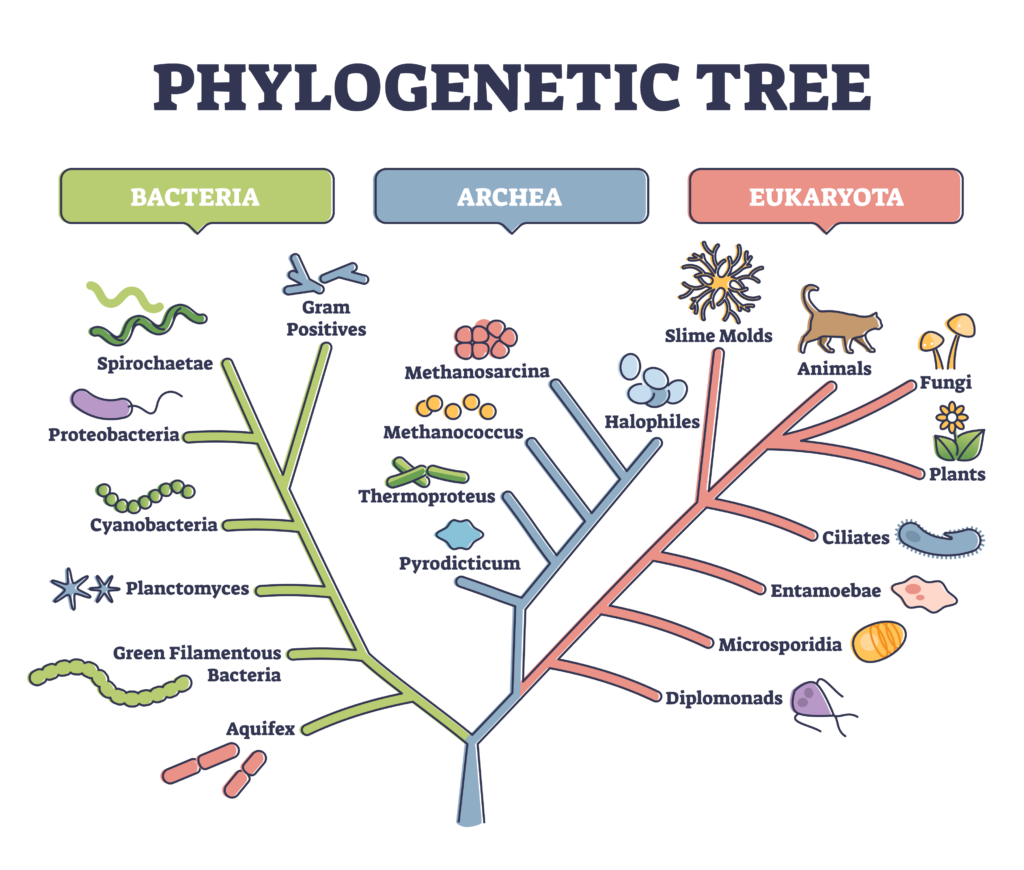
One cast, two ways to sort it
The same 13 microbes — by family tree, or by where they live.
Bacteria
E. coliCyanobacteriaDesulforudisArchaea
MethanogenHalophileThermophileEukarya
DiatomPlasmodiumAmoebaYeastOff the tree (not cellular life)
InfluenzaBacteriophagePrionYour gut & body
E. coliMethanogenPlasmodiumInfluenzaPrionOcean
CyanobacteriaDiatomBacteriophageSoil & freshwater
YeastAmoebaExtremes (vents · brine · deep rock)
ThermophileHalophileDesulforudisNotice the colours don't change — each microbe keeps its identity. Only the filing system changes. "Microbe" is a label that cuts straight across biology.
Apps and Learning Resources
Fantastic resource for Micorbial species
University of Utah Genetics great resource for getting an idea of how small microbes can be.
Please checkout the entire HHMI website. This is a link to their great virus explorer tool.
Considerations
The most basic living things on earth have found some of the most interesting and robust moethods for survival.
They show that being simple is a valid strategy and it has allowed them to be the most wide ranging group that lives in the the absolute harshest conditions that any living on out planet has been able to survive.
Microbes is not a taxonomically distinct category, but I believe a useful category to try and introduce the absolute wonders and oddities that can be found in the living things that are usually too small for any to notic ein their every day life.
Some can be dangerous to humans, but many are not. They comprise a world of living things that go unnoticed every day.
Also virus’s not classified as alive, but things can get more confusing or interesting when you talk about giant viruses.
Also Protists are the wild west of microbes. They refuse classification.